

Herb Bai He (lily bulb) nourishes Lung Yin and soothes emotional agitation, helping you relieve dry cough, insomnia, and anxiety when used in soups, decoctions, or gentle tonics under professional guidance.
Key Takeaways:
- Bai He (Lily bulb) nourishes Lung Yin and moistens the lungs, easing dry cough, dry throat, and yin-deficiency heat signs.
- Bai He enters the Heart and Lung channels and calms the spirit, supporting treatment of insomnia, irritability, and anxiety from yin deficiency.
- Use caution with cases of profuse greasy phlegm or spleen yang deficiency; avoid when dampness and loose stools predominate.
Botanical Identity and TCM Properties
Bai He (Lilium brownii and related species) appears in TCM as a moistening, slightly cool bulb that nourishes Lung Yin and calms the Heart; you will find it indicated for dry cough, night sweats, and insomnia with irritability.
Taxonomically, several Lilium species supply the bulb used clinically, and you should verify species and processing to ensure the proper Yin-nourishing and spirit-calming effects.
Botanical & TCM summary
| Botanical identity | Lilium brownii, L. lancifolium and related bulbs used medicinally |
| TCM actions | Nourishes Lung Yin, clears heat from Yin deficiency, calms Shen |
| Common uses | Dry cough, irritability, insomnia, Yin deficiency signs |
Characteristics of Lilium brownii and Related Species
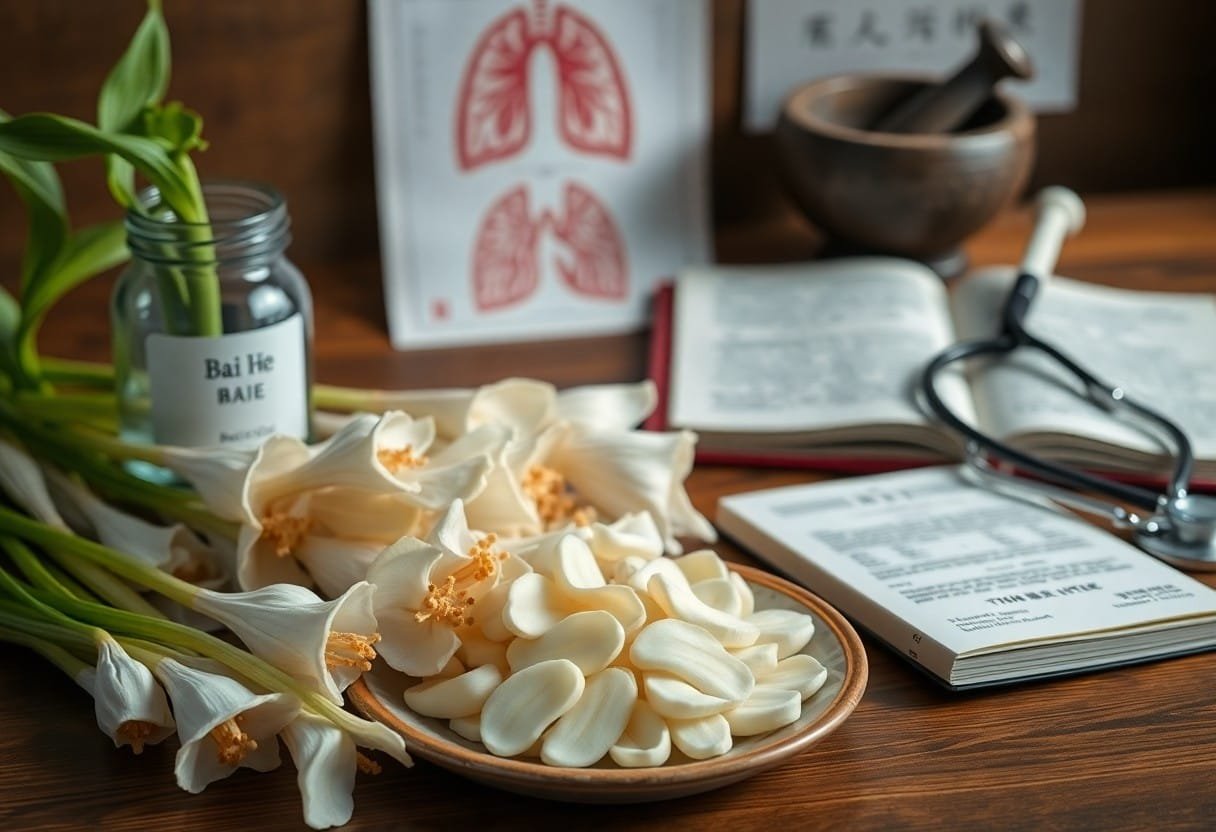
Lilium brownii bulbs are typically elongated with white to pale flesh and a mildly sweet aroma; you should inspect bulbs for density and intact scales as markers of quality.
Wild populations and cultivated strains vary in bulb size and scent, and you should prefer heavier, unblemished bulbs for stronger therapeutic effect.
Morphology and sourcing
| Bulb appearance | Elongated, layered scales, pale white flesh |
| Quality indicators | Heavy weight, intact scales, faint sweet aroma |
| Processing notes | Often dried; avoid mold and excessive heat during drying |
Energetic Profile: Taste, Temperature, and Meridians
Taste of Bai He is mildly sweet with a faint bitterness, and you can use that profile to moisten Lung Yin and gently calm the Heart Shen.
Temperature is neutral to slightly cool, which explains why you apply it for Yin deficiency with low-grade heat and dryness rather than for cold syndromes.
Meridian entry is primarily Lung and Heart, so you should combine Bai He with other Yin-nourishing herbs when addressing concurrent Heart-related insomnia or anxiety.
Energetic profile
| Taste | Mildly sweet, slightly bitter |
| Temperature | Neutral to slightly cool |
| Meridians | Lung, Heart |
Therapeutic Actions for Respiratory Health
Bai He soothes your lungs, replenishes Lung Yin, and calms restlessness; see Research progress on classical traditional Chinese … for related studies.
Clinical practice pairs Bai He with moistening and nourishing herbs when you present with chronic dry cough, hoarseness, or sleep disturbance linked to Yin deficiency.
Nourishing Lung Yin and Moistening Dryness
You can expect Bai He to enrich pulmonary fluids, relieve throat dryness, and soften phlegm from Yin depletion, improving mucosal lubrication and breath comfort.
Clearing Heat to Relieve Chronic and Blood-Streaked Cough
Herb helps you clear mild lung heat that promotes red or blood-streaked sputum, cooling inflamed airways and reducing irritation that provokes bleeding.
Evidence from pharmacological reports suggests anti-inflammatory and mild hemostatic actions, so you may combine Bai He with cooling, blood-staunching herbs for persistent bloody coughs.
Addressing Emotional Disturbances and the Shen
Bai He supports your Lung Yin and soothes emotional turbulence, helping you experience less restlessness and tearfulness while underlying Yin is replenished.
You may notice calmer sleep and reduced rumination as Bai He is incorporated into formulas that address both Heart and Lung deficiencies.
Calming the Heart and Stabilizing the Mind
Lily bulb tonifies Heart and Lung Yin to quiet palpitations and ease anxiety, allowing you to regain mental steadiness without heavy sedation.
When paired with herbs that anchor the shen, you can use Bai He to stabilize mood swings and lessen intrusive thoughts while treating core Yin deficiency.
Clinical Management of “Lily Bulb Syndrome” (Bai He Bing)
Clinical presentation of Bai He Bing often includes persistent crying, social withdrawal, poor appetite and night sweats; you should assess for Lung and Heart Yin deficiency and concurrent phlegm-heat.
Treatment protocols typically combine Bai He with nourishing, cooling herbs, dietary adjustments and acupuncture so you can restore Yin, reduce irritability and normalize sleep.
Monitoring your response-mood, sleep, appetite and tongue-guides dosage and formula adjustments, and you must refer to a licensed practitioner if severe withdrawal, suicidality or psychosis appears.
Modern Phytochemical and Pharmacological Insights
Research identifies steroidal saponins, polysaccharides, alkaloids, and flavonoids in Bai He, linking these constituents to lung-yin nourishment, sedative effects, and immune modulation; you can see integrated analyses in Insights from the Perspective of Traditional Chinese Medicine, which aligns phytochemistry with clinical observations.
Bioactive Saponins, Polysaccharides, and Alkaloids
Saponins provide membrane-active and neuroactive properties while polysaccharides contribute to mucosal hydration and immunoregulatory activity; you will find alkaloids at lower concentrations that may modulate CNS responses, and extract composition varies with processing and source.
Anti-inflammatory, Sedative, and Immunomodulatory Effects
Extracts reduce proinflammatory cytokines and show anxiolytic and sedative effects in animal models, suggesting you may obtain symptomatic relief in cough, insomnia, and stress-related presentations when Bai He is used appropriately.
Mechanistic work points to NF-κB and MAPK pathway inhibition by saponins, polysaccharide-driven innate immune modulation, and mild GABAergic effects from other constituents, which you can factor into multiherbal formulations and clinical decisions.
Traditional Formulations and Synergistic Pairings
Traditional formulas often combine Bai He with yin-nourishing and calming herbs so you can address both Lung yin deficiency and emotional agitation in a single regimen, balancing moisture and spirit without harsh sedatives.
Combinations with Shu Di Huang, Mai Men Dong, and Sheng Di strengthen yin and reduce irritability, allowing you to sustain respiratory health while gently moderating anxiety and insomnia common with chronic dryness.
Classic Applications in Bai He Gu Jin Tang
Bai He Gu Jin Tang centers Bai He with Rehmannia and Ophiopogon to transform dry phlegm and nourish Lung and Kidney yin, giving you relief from chronic dry cough, night sweats, and low-grade emotional distress.
Culinary Integration for Long-term Tonic Use
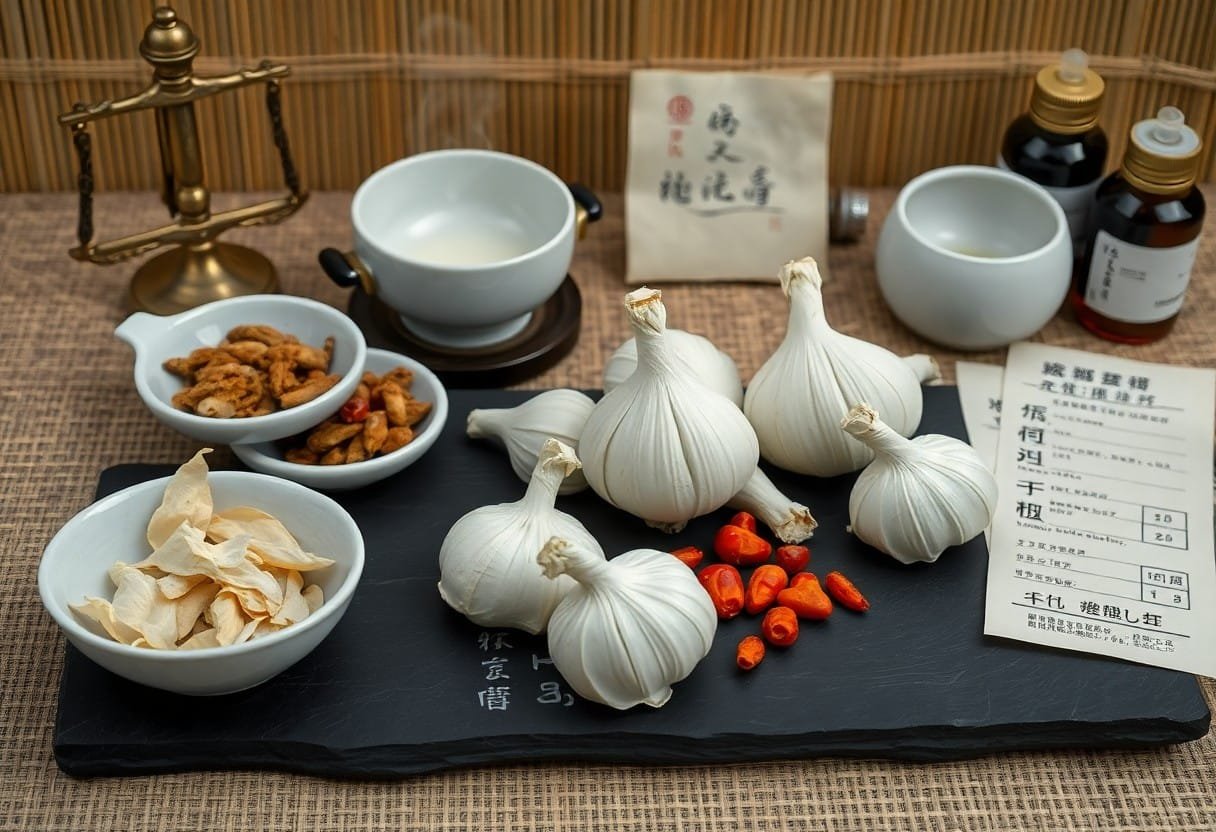
Incorporating Bai He into congee, soups, or stewed desserts lets you use it as a gentle, ongoing tonic; you can sip these preparations regularly to support lung moisture and a calmer mood while preserving its delicate texture.
Pair lily bulb with goji, Chinese yam, and a touch of rock sugar for a harmonizing tonic you can enjoy weekly, adjusting quantities to your constitution and observing how your cough and emotional steadiness respond.
Safety Guidelines and Contraindications
You should consult a qualified practitioner before using Bai He if you take medications for respiratory or mental health, if you are pregnant, or if you have severe chronic illness; consider standardized options like Lily Bulb Extract Powder and follow labeled dosing.
Avoid combining Bai He with sedatives, strong diuretics, or immunosuppressants without professional advice, and discontinue use if you develop allergic reactions, pronounced gastrointestinal upset, or worsening respiratory symptoms.
Differentiating Quality and Proper Preparation
Check supplier transparency and batch testing to ensure purity, and prepare dried bulbs by gentle soaking and simmering so you preserve lung-yin properties while reducing raw coldness that can stress digestion.
Precautions for Spleen Deficiency and Cold-Dampness
When you have signs of spleen deficiency or cold-dampness, expect possible loose stools, heaviness, or reduced appetite and reduce dosage or avoid raw Bai He preparations until a practitioner advises otherwise.
Pair Bai He with mild warming culinary herbs like ginger only after consulting your practitioner, and monitor bowel function during initial use to adjust preparation and dosing promptly.
Summing up
Conclusively Bai He (lily bulb) nourishes Lung Yin, moistens the lungs, relieves dry cough, and soothes emotional disturbance linked to yin deficiency. You can use it in decoctions, soups, or powdered form to ease insomnia, anxiety, and irritability, and you should consult a qualified practitioner for dosing and interactions.