
You can use Ba Yue Zha (Akebia Fruit) to soothe liver Qi stagnation pain, offering pain relief and qi-moving effects; overdose risks and pregnancy contraindications require caution and professional supervision.
Botanical Profile and Traditional Preparation
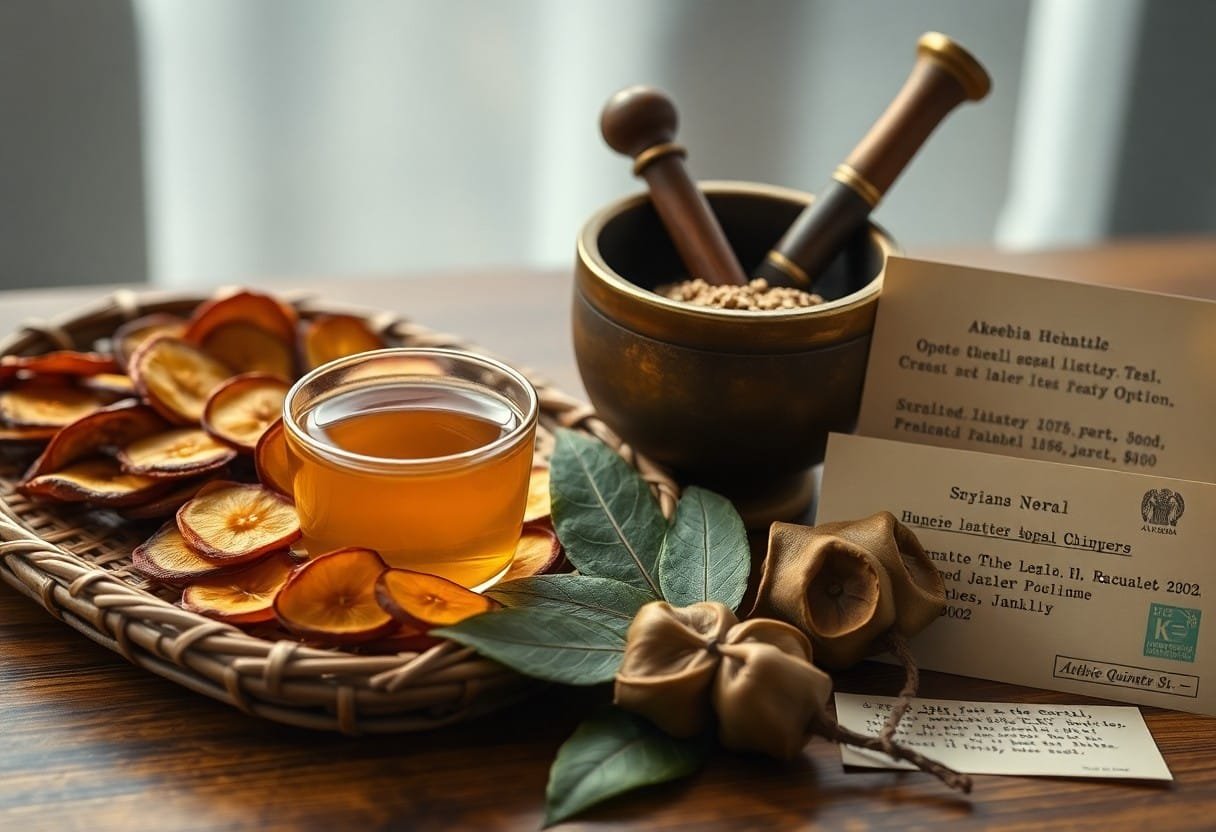
Akebia quinata is a twining vine with distinct five-leaflet compound leaves, clusters of purple flowers, and elongated pods; you can identify the fruit by its soft, translucent pulp surrounding numerous seeds.
You will find the pulp used fresh or dried in formulas, while the outer rind is typically sun-dried or stir-fried to modify its action; note the seeds are mildly bitter and should be handled cautiously.
Identification of Akebia quinata and Related Species
Leaves form in five-leaflet clusters and the vine’s twining habit helps you separate Akebia from many look-alikes, with leaflet count and vine habit as clear field cues.
Flowers are small and often purple-brown, and you should compare fruit shape and seed arrangement to distinguish A. quinata from A. trifoliata or other related species.
Harvesting and Processing the Mature Fruit
Harvest fruits when the pods begin to split and the pulp yields easily, and you should avoid overripe specimens since fermentation increases spoilage and reduces quality.
After harvest you should remove pulp promptly, dry the rind in shade or low heat to preserve active constituents, and store dried material in airtight containers away from moisture to prevent mold and loss of efficacy.
Traditional Chinese Medicine Energetics
You encounter Ba Yue Zha as a qi-moving agent that targets stagnation in the chest and flanks, offering pain relief for Liver Qi congestion; you should regard it as a dispersing tonic best used in short courses under guidance.
Nature, Flavor, and Meridian Tropism
Warm and slightly acrid, Ba Yue Zha directs movement outward and upward, which helps release constrained qi; you will note its affinity for the Liver and Stomach meridians, guiding formulas toward flank discomfort and digestive tension.
Role in Harmonizing the Liver and Stomach
As you integrate it into prescriptions, Ba Yue Zha soothes Liver Qi stagnation and moderates rebellious qi, often paired with harmonizing herbs to restore flow between the Liver and Stomach and reduce emotional or digestive pain.
Use caution if you are pregnant, breastfeeding, or display signs of Yin or fluid deficiency; consult a licensed practitioner because improper use can aggravate yin injury despite its strong moving action.
Therapeutic Actions on Liver Qi Stagnation
Ba Yue Zha moves constrained Liver qi to ease chest and flank tightness, helping you regain a freer, less constricted breath and posture. It is particularly effective for patterns where stagnation, not heat or deficiency, is the primary issue, offering a gentle soothing of emotional constraint.
You will notice relief in tension-related symptoms as Ba Yue Zha unblocks qi pathways and reduces palpable distention, making it a useful choice when pain and fullness stem from stagnation rather than inflammatory causes.
Resolving Emotional Constraint and Distention
Clinical use shows Ba Yue Zha softens the physical expression of grief, frustration, and irritability so you experience less chest tightness and sighing; it promotes emotional release without sedation and supports mood regulation through improved qi flow.
When you combine it with other liver-soothing herbs it enhances resolution of distention and tension, helping the diaphragm and chest relax so emotional constraint translates less often into somatic pain.
Alleviating Hypochondriac and Epigastric Pain
Patients report reduced hypochondriac and epigastric pain as Ba Yue Zha directs stagnant qi outward and downward, softening nodules and relieving pressure; this action makes it a practical option for pain tied to qi stagnation rather than structural injury, providing marked symptomatic relief.
Combined in formulas that harmonize the Middle Jiao, Ba Yue Zha helps ease epigastric fullness and flank soreness while supporting digestive function, though you should adjust combinations if deficiency signs appear to avoid over-moving the qi.
Use caution if you are pregnant or have active bleeding; monitor for mild gastrointestinal upset and avoid prolonged high doses-do not use during pregnancy and consult a qualified practitioner when in doubt.
Clinical Applications and Herbal Synergy
Clinically, Ba Yue Zha is employed to move Liver Qi and relieve pain, so you will often see it used where hypochondriac or menstrual pain stems from stagnation; you should use caution in pregnancy and under severe deficiency.
Practitioners combine it with qi-moving, blood-invigorating, and phlegm-transforming herbs to address mixed patterns; you must balance prescriptions with spleen-supportive agents if digestion is weak to avoid aggravating deficiency.
Combinations for Moving Qi and Relieving Pain
You pair Ba Yue Zha with Bupleurum (Chai Hu) and Cyperus (Xiang Fu) to smooth Liver pathways, and with analgesic movers like Corydalis (Yan Hu Suo) or Aucklandia for stronger pain relief; this synergy intensifies symptomatic relief.
Combine it into formulas that simultaneously address qi stagnation and blood stasis, tailoring adjuncts for damp or spleen deficiency; you should monitor dosing closely to prevent masking more serious conditions.
Addressing Scrophula and Internal Masses
Targeting scrofulous nodules and internal masses, you add Ba Yue Zha to regimens that soften hardness and disperse stagnation, while pairing with herbs that transform phlegm; do not rely on herbs alone if malignancy is suspected.
Include biomedical assessment and imaging when lumps persist or worsen; you must stop herbal therapy and seek urgent evaluation for systemic signs like unexplained weight loss or bleeding, as delay can be dangerous.
Observe treatment response over weeks-reduction in pain or softening of nodules can occur, but you should maintain close follow-up and professional supervision, discontinuing use and referring if masses progress.
Contemporary Pharmacological Research
Recent pharmacological investigations show Akebia extracts modulate inflammatory pathways, bile secretion, and nociceptive signaling, so you can link these actions to relief of liver qi stagnation pain. Preclinical data emphasize triterpenoid saponins as primary active constituents, supporting traditional analgesic use.
Laboratory models employ enzymatic assays, cytokine profiling, and behavioral pain tests to map mechanisms; you will find consistent anti-inflammatory and cholagogic signals across studies. Evidence remains largely preclinical and requires rigorous clinical validation.
Analysis of Triterpenoid Saponins and Active Compounds
Chemical profiling identifies oleanane-type and related triterpenoid saponins alongside flavonoids and sterols, and you should consider these as the main bioactives behind analgesic and hepatoregulatory effects. Saponins demonstrate receptor and enzyme modulation in vitro.
Spectroscopic and chromatographic methods allow quantification and structural characterization so you can assess batch variability and standardize extracts; variation in saponin content directly affects efficacy and safety.
Modern Studies on Anti-inflammatory and Anti-tumor Properties
Animal studies report reduced inflammatory cytokines, decreased edema, and attenuated pain behaviors after Akebia administration, giving you mechanistic support for its traditional use. Anti-inflammatory effects are reproducible across models.
Cellular research reveals suppression of NF-κB signaling and induction of apoptosis in certain tumor lines, but you should view anti-tumor claims as preliminary and context-dependent. Anti-tumor findings remain early and dose-sensitive.
Clinical evidence is limited to small trials and case reports that suggest symptomatic biliary and visceral pain relief, and you must weigh these benefits against reports of dose-related adverse events; watch for potential herb-drug interactions and hepatic effects.
Safety, Dosage, and Contraindications
You should avoid Ba Yue Zha during pregnancy and use caution while breastfeeding, since it moves qi and may affect uterine activity; consult a qualified practitioner if you have bleeding disorders or take anticoagulants.
If you experience nausea, abdominal pain, allergic reactions, or other adverse effects, stop use immediately and seek medical attention; severe reactions require prompt care.
Recommended Dosage and Decoction Standards
Typical adult dosage is 3-9 g as a decoction; you should only adjust this under practitioner guidance and never exceed recommended amounts without supervision.
When you prepare a decoction, bruise the fruit and simmer for about 15-20 minutes, combining with complementary herbs to balance drying or warming tendencies.
Precautions for Spleen and Stomach Deficiency
Avoid Ba Yue Zha if you have marked spleen and stomach deficiency with loose stools, poor appetite, or chronic fatigue; severe digestive weakness is a contraindication.
Monitor your digestion while using this herb and reduce dose or discontinue if you develop worsening diarrhea, bloating, or unintended weight loss; seek practitioner advice for persistent symptoms.
Combine Ba Yue Zha cautiously by pairing it with spleen-tonifying herbs such as atractylodes or fresh ginger when mild deficiency exists, but always consult a TCM practitioner before modifying formulas.
Conclusion
Considering all points, Ba Yue Zha (Akebia fruit) offers gentle relief for liver qi stagnation pain through bitter, dispersing actions and mild analgesic effects, and you can consider it as part of a targeted herbal approach when aligned with a correct diagnosis. Consult reputable sources, such as Fat – Herb of the Week: Ba Yue Zha Also …, before use.